
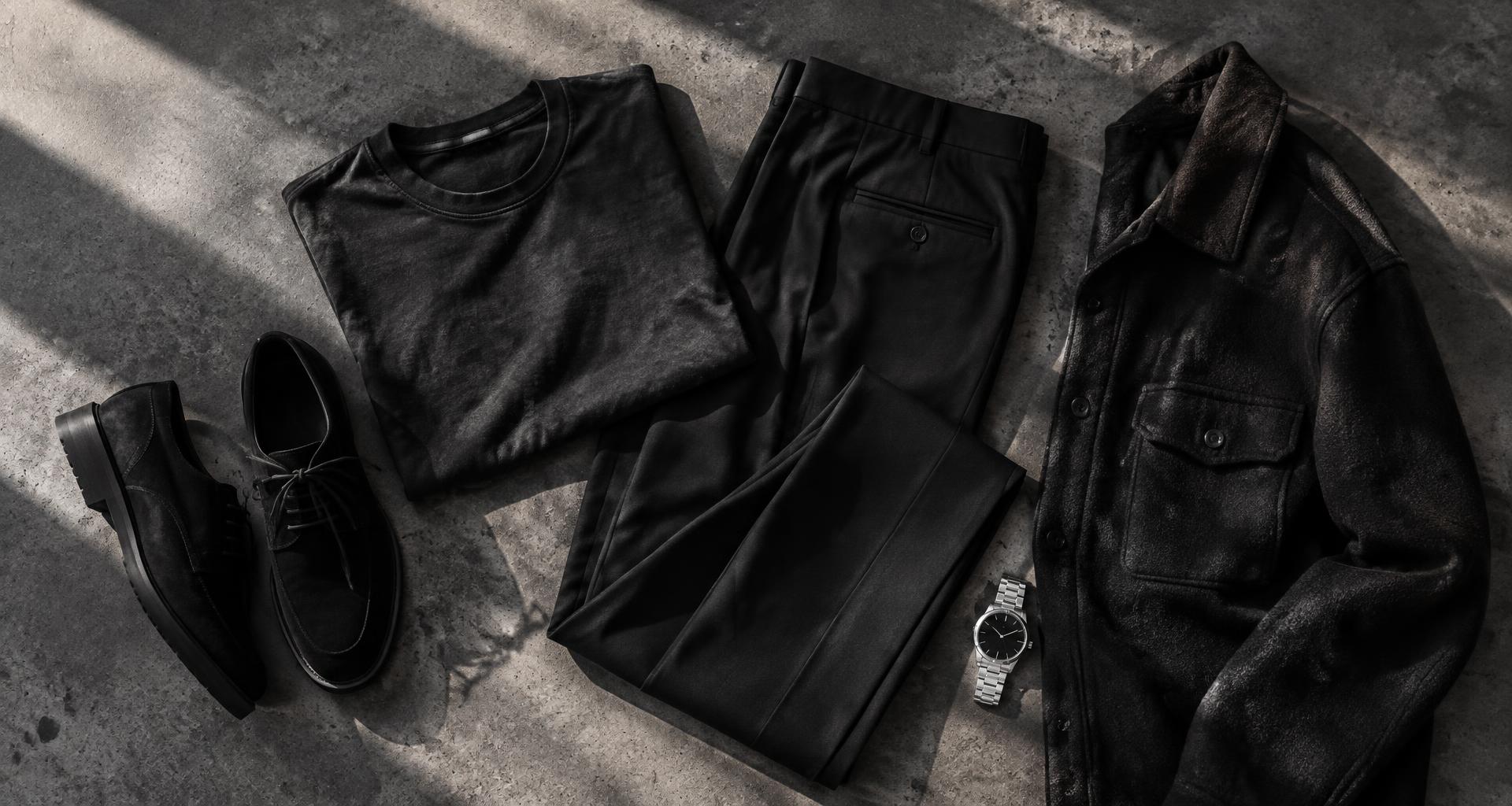
Black is one of the easiest colours to wear.
It is also one of the easiest to get wrong.
A completely black outfit can look sharp, understated and intentional.
Or it can look flat.
The difference usually has very little to do with colour.
It comes down to texture.
Proportion.
Fabric.
Fit.
And the way the individual pieces relate to each other.
Wearing black well is not about adding more.
It is about making fewer things matter more.
Start with different textures
If every piece is the same shade and the same surface, the outfit can quickly lose definition.
A black cotton T-shirt.
Black wool trousers.
Black suede shoes.
Black denim.
Black linen.
Black leather.
They may all share the same colour, but they do not look the same.
That difference creates depth.
When colour is removed, texture becomes more important.
A smooth T-shirt next to a brushed overshirt already gives the eye something to work with.
You do not need a pattern.
The fabric can do enough.
Do not rely on one shade of black
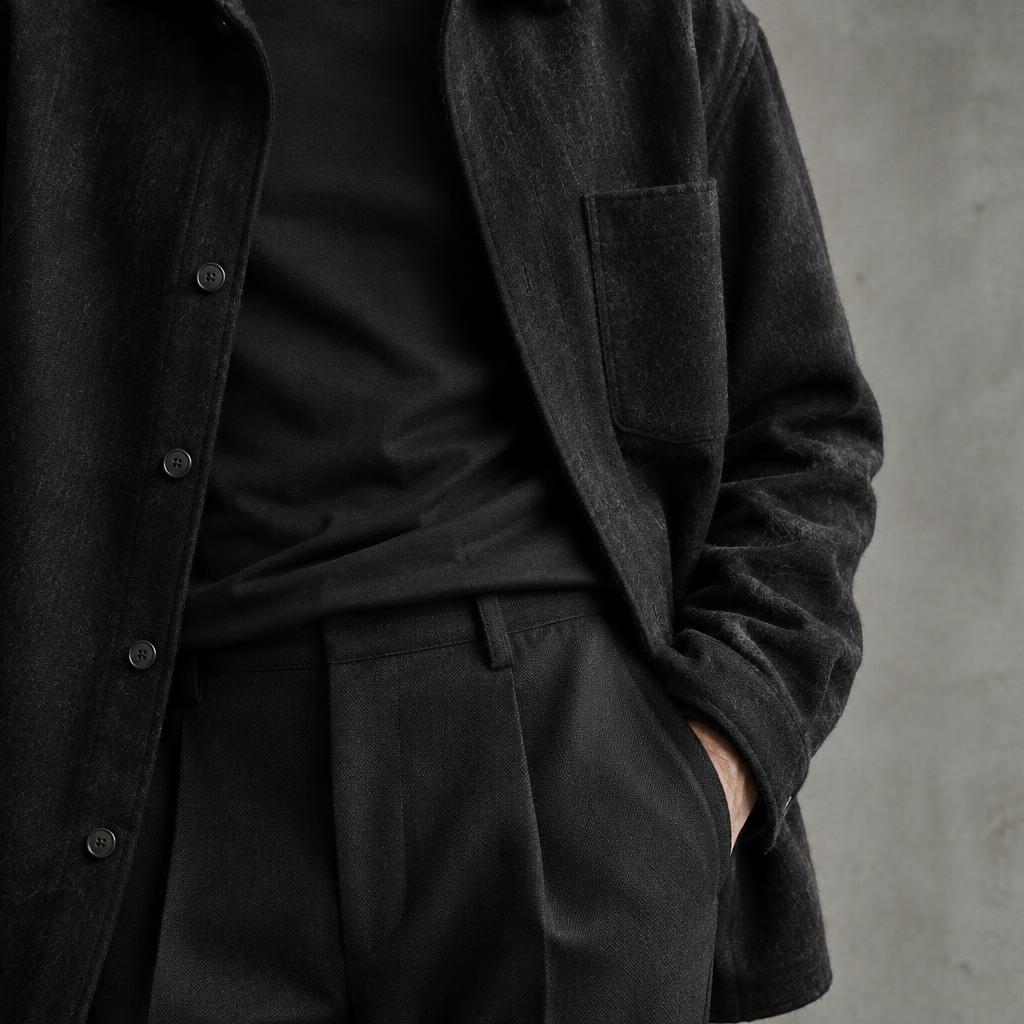
Black is rarely just black.
Washed black.
Charcoal.
Deep graphite.
Faded black.
Soft black.
Jet black.
Small tonal differences can make an outfit feel more considered.
A washed black T-shirt with darker trousers can create separation without breaking the monochrome look.
The contrast is subtle.
That is often exactly what makes it work.
Proportion becomes more visible
When colour is restrained, silhouette matters more.
A fitted black T-shirt with straight trousers creates a different impression from an oversized black shirt with relaxed trousers.
Neither is automatically better.
The important thing is balance.
If the top is loose, the trousers may need a little more structure.
If the trousers are wider, the top can be cleaner.
Head-to-toe black can easily become shapeless if every piece has the same volume.
Give the outfit a line.
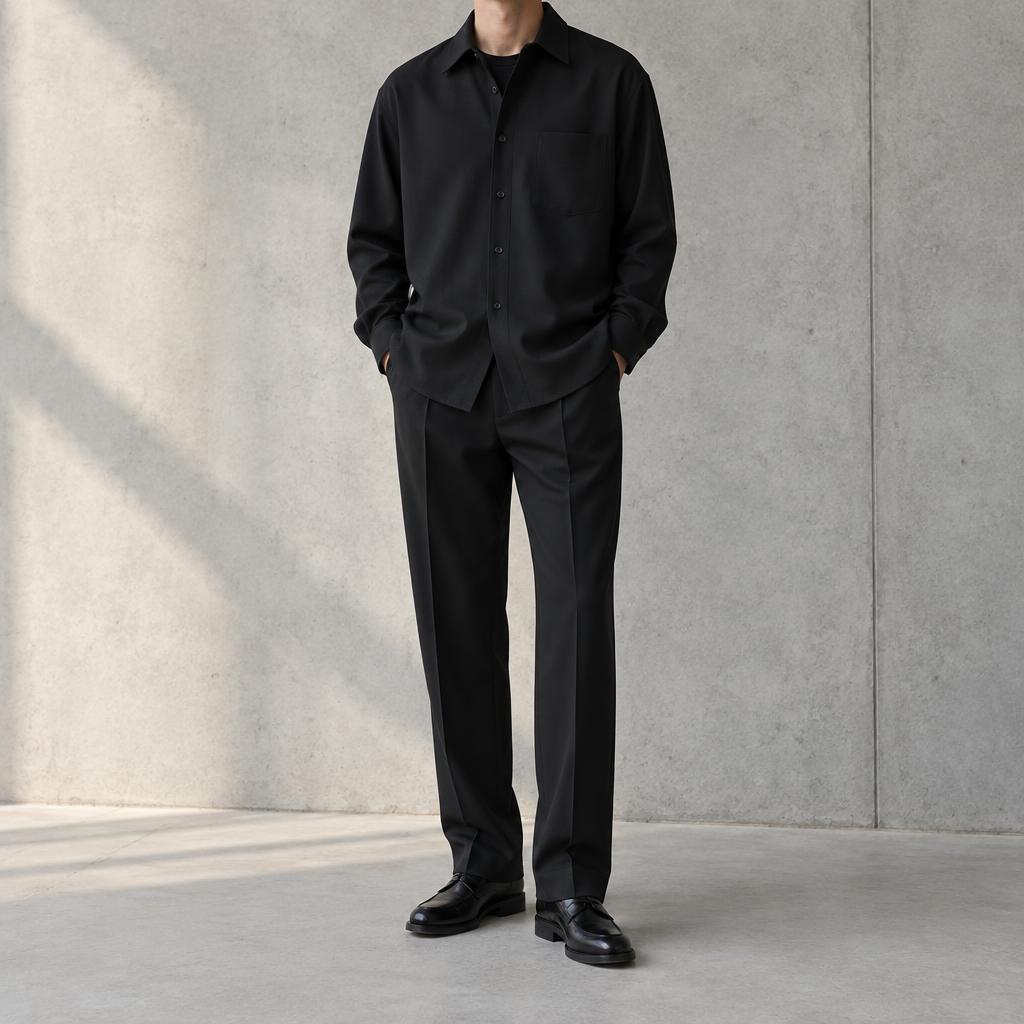
Fit matters more than branding
Black clothing often looks strongest when the detailing is quiet.
That puts more pressure on fit.
Where does the shoulder sit?
How long is the T-shirt?
Where do the trousers break?
How wide is the leg?
Does the shirt fall cleanly?
When there is little distraction, those details become the outfit.
Large branding is not needed to make black clothing interesting.
Good proportion already does the work.
Use one point of contrast
An all-black outfit does not have to remain completely black.
One small interruption can be enough.
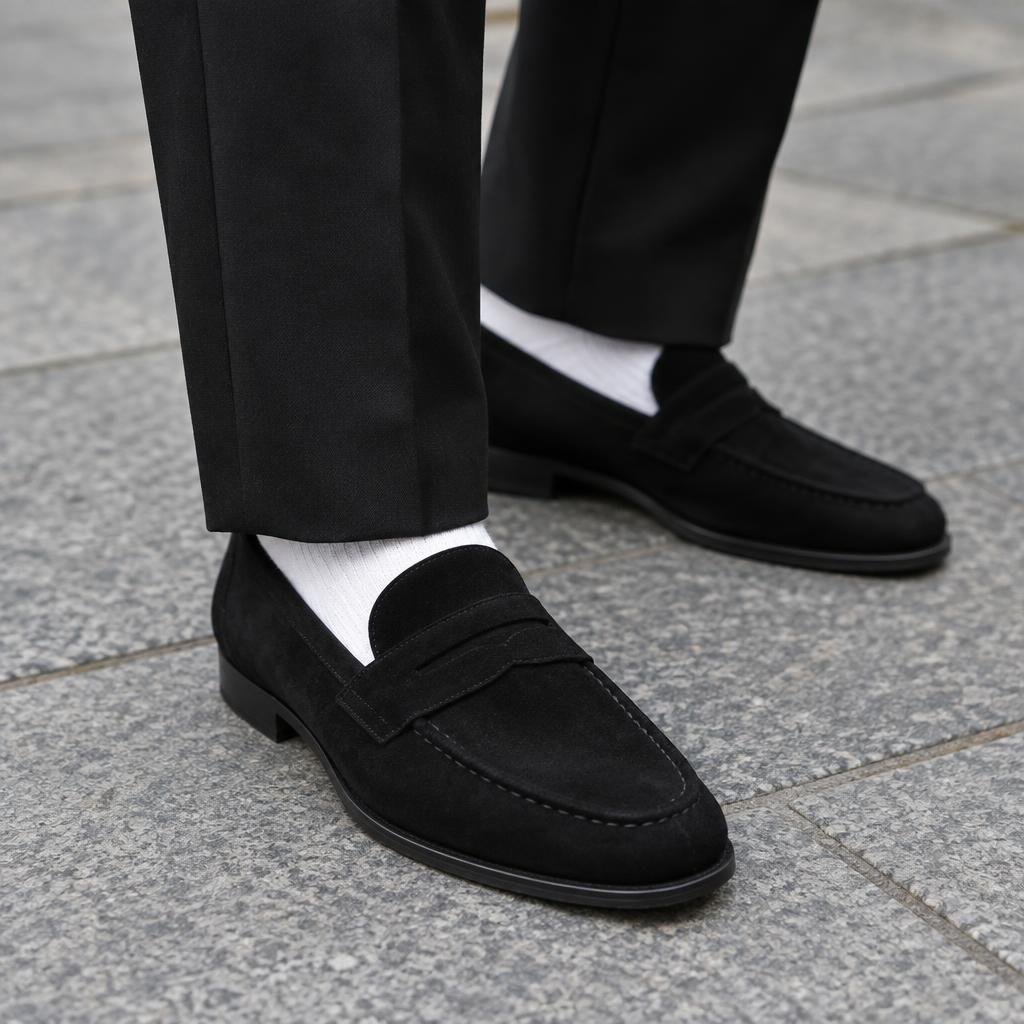
White socks.
A silver watch.
A muted red detail.
A natural leather accessory.
A lighter pair of shoes.
The point is not to add colour for the sake of it.
It is to create one clear moment of contrast.
If everything else is restrained, even a small detail becomes noticeable.
That is usually more effective than introducing several competing colours.
Black works differently in different fabrics
A black linen shirt feels completely different from a black heavyweight cotton shirt.
A black wool trouser looks different from black denim.
A black suede shoe softens the outfit in a way that polished leather does not.
This is why material choice matters.
The colour may stay the same.
The mood changes.
For summer, black can feel lighter in linen or thin cotton.
For autumn, wool, brushed cotton and suede add depth.
The palette remains consistent.
The season changes through texture.
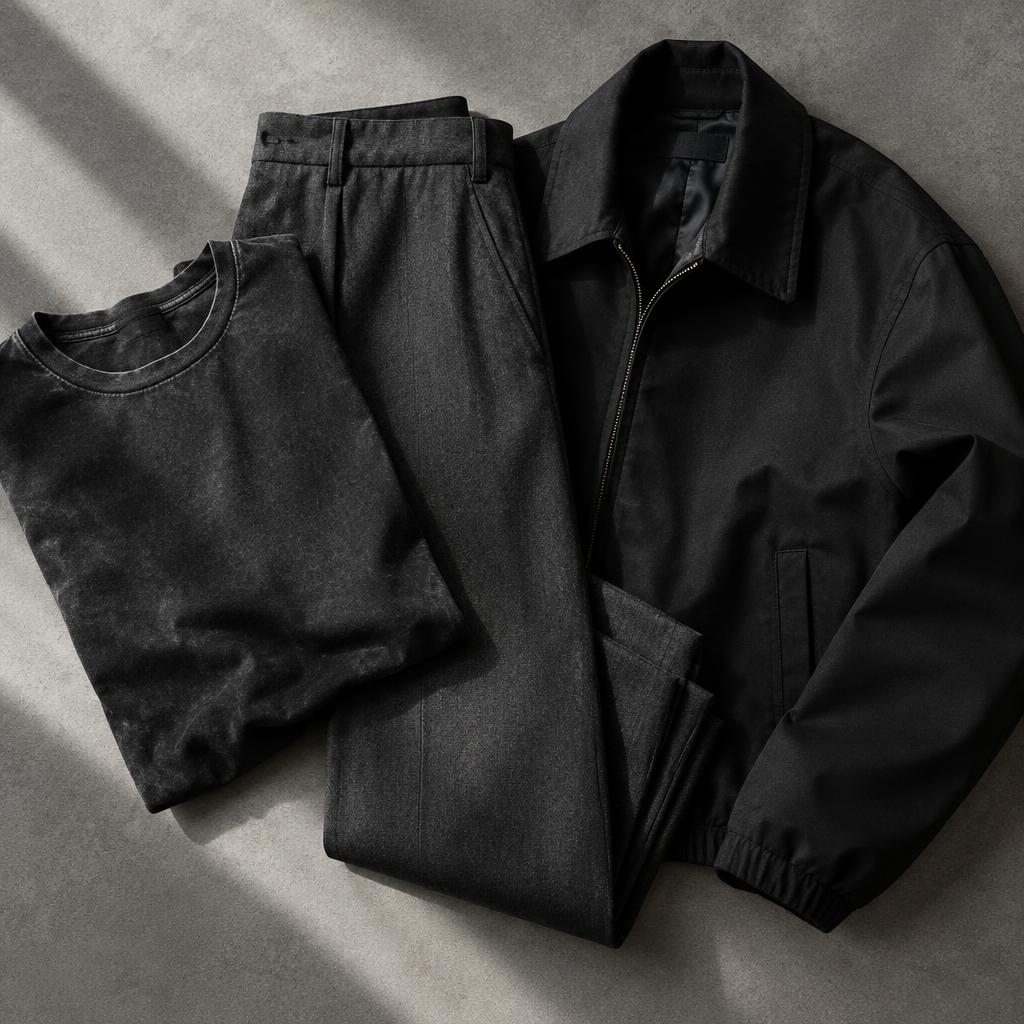
For a seasonal starting point, see the men’s autumn capsule wardrobe.
Avoid making every piece too severe
Black can sometimes become overly sharp when everything is too structured.
Slim trousers.
Tight T-shirt.
Hard leather shoes.
Structured jacket.
The result can feel more formal or aggressive than intended.
One relaxed element can soften the whole look.
A slightly looser trouser.
A soft overshirt.
A washed T-shirt.
A suede shoe.
Minimal style does not need to feel rigid.
Use layering to create depth
Black works particularly well when layered because each garment creates a new edge.
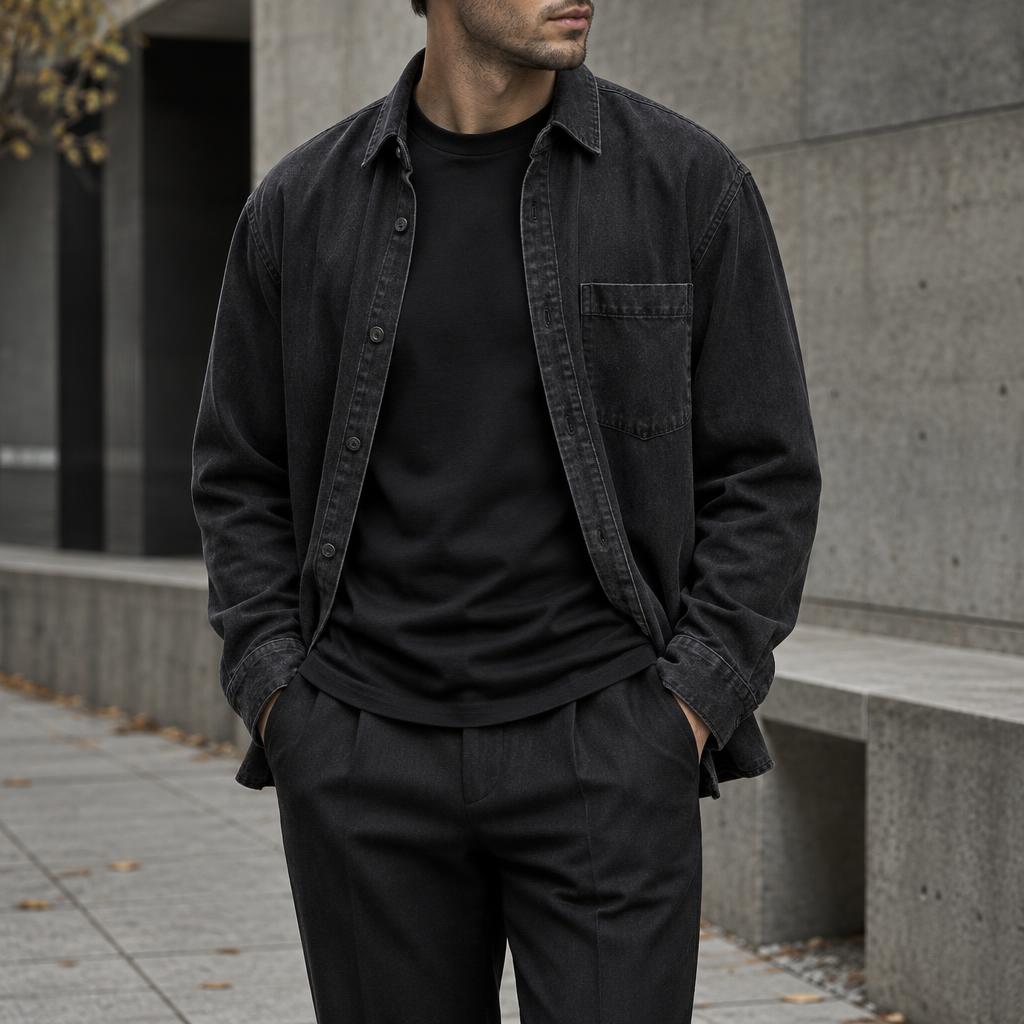
A black T-shirt under a black overshirt.
A dark jacket over both.
Similar colours.
Different shapes.
The small differences in fabric and tone help each layer remain visible.
This is especially useful in autumn, where layering can add depth without introducing extra colour.
The outfit stays quiet.
But not flat.
For more on building depth without adding weight, read how to layer clothes without looking bulky.
Keep the footwear simple
Shoes can change an all-black outfit very quickly.
Black trainers keep things casual.
Black leather shoes make it sharper.
Black boots add weight.
Suede softens it.
White trainers create a stronger break.
There is no single correct option.
The important thing is that the shoe matches the overall proportion.
Heavy boots under very slim trousers can dominate.
Delicate footwear beneath very wide trousers can disappear.
Balance matters more than colour.
Black in warm weather still works
Black is often treated as a cold-weather colour.
It does not need to be.
In warm climates, the fabric becomes more important than the shade.
Lightweight cotton.
Linen.
Open weaves.
Relaxed silhouettes.
A black summer outfit can still feel light if the garments themselves are designed for heat.
Heavy black clothing will feel heavy.
Light black clothing does not have to.
The colour is only one part of the equation.
Mix black with neutrals
If full monochrome feels too severe, introduce one neutral.
Black and stone.
Black and grey.
Black and white.
Black and olive.
Black and sand.
These combinations keep the outfit restrained while creating enough contrast to separate the pieces.
A black T-shirt with stone trousers can feel just as minimal as an all-black look.
Minimalism is not about refusing colour.
It is about controlling it.
Avoid over-accessorising
All-black outfits already have a strong identity.
They do not need much added to them.
A watch.
Sunglasses.
A bracelet.
Perhaps one small piece of jewellery.
That is often enough.
Too many accessories can start competing with the simplicity that made the outfit work in the first place.
Restraint is part of the look.
Washed black can feel more natural
Pure black can sometimes feel formal.
Washed black behaves differently.
It feels softer.
More lived in.
Less precise.
That makes it particularly useful for casual pieces such as T-shirts, denim and overshirts.
It can also make monochrome outfits easier because slight fading naturally creates tonal variation.
Black does not need to remain perfect to remain useful.
Sometimes wear improves it.
Let one piece do the work
Not every garment needs to be interesting.
If the jacket has a strong texture, the T-shirt can stay simple.
If the trousers have a wider silhouette, the shirt does not need additional detail.
If the shoes are the focal point, everything above them can remain quiet.
Trying to make every piece stand out usually makes the outfit less coherent.
Choose one thing.
Let everything else support it.
Black should still feel personal
A black wardrobe can become anonymous if it is treated like a uniform with strict rules.
It should still reflect how you dress.
Perhaps you prefer loose trousers.
Perhaps you always wear a cap.
Maybe your shoes are the only part of the outfit that changes.
Perhaps you prefer crisp black clothing.
Perhaps you like it faded and worn.
Minimal does not mean identical.
The details are where personality lives.
For the broader approach, read minimalist men’s style: wearing less, better.
Why black keeps working
Trends change.
Silhouettes change.
The way black is worn changes.
But the colour remains useful because it removes one decision.
It works easily with itself.
It works with most neutrals.
It can move between casual and smart.
It allows texture and shape to become more visible.
That is why black continues to return.
Not because it is dramatic.
Because it is dependable.
Wear black with intention
The easiest way to stop black from looking boring is not to add more colour.
It is to pay more attention.
Different textures.
Slight tonal variation.
Balanced proportions.
Good fabric.
One point of contrast.
Fewer unnecessary details.
Black works best when the outfit feels considered rather than complicated.
The colour stays quiet.
Everything else becomes clearer.
Less noise. More detail.
More experience. Less excess.
You might also like
Guide — September 2026
Minimalist Men’s Style: Wearing Less, Better
Guide — October 2026