The Design Code / Objects & Function / 04
Tools That Earn Their Place
Why the grip of a peeler or the balance of a pair of scissors keeps us reaching for the same one for years.
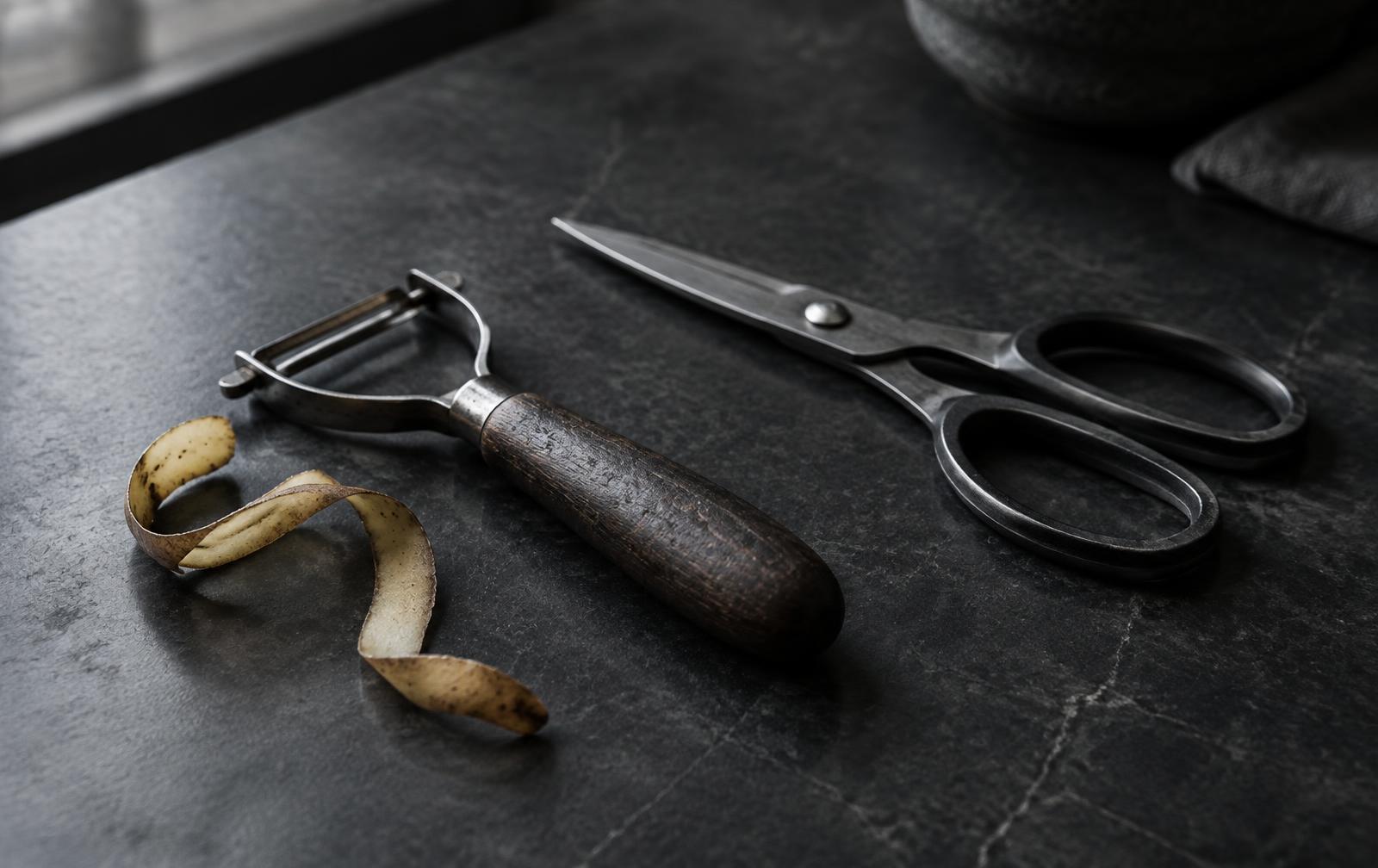
There are two peelers in the kitchen drawer. One came with a set and still looks new. The other has a handle worn smooth where your thumb rests.
Ask why you keep reaching for it and you might have to peel a potato to find the answer.
I
A blade that follows the curve
Watch what happens as the peeler reaches the rounded end of the potato. The handle stays fairly steady in your palm while the blade pivots to follow the surface. A thin strip of skin curls away. Your other hand turns the potato a fraction, ready for the next stroke.
Try the same movement with damp hands and the handle becomes more interesting. A slight swell gives your curled fingers something to hold. A flatter patch beneath your thumb tells you which way the blade faces while your eyes are still on the bit of peel you missed.
A flatter patch beneath your thumb tells you which way the blade faces while your eyes are still on the bit of peel you missed.
II
The balance of a pair of scissors
Pick up a pair of household scissors and open them slowly. You can feel the weight of the blades ahead of your knuckles and the resistance at the pivot. As you close the handles around a sheet of paper, the point where the blades meet travels away from your hand. A smooth pivot lets you guide that moving point along a pencil line, even around a bend.
Balance is easiest to notice on a longer cut. If the tips keep dipping, your wrist has to lift them. With a pair that sits comfortably in your hand, you can keep your attention on the line all the way to the far edge of the sheet.
With a pair that sits comfortably in your hand, you can keep your attention on the line all the way to the far edge of the sheet.
III
What the drawer remembers
The bright patch on a scissor handle records where a finger has rested through years of cutting string, opening parcels and trimming paper. By then, you know how far to open the blades for each job. Much of what makes a tool feel right belongs to the hand that has learnt to use it.
Next time you reach into the drawer, notice how early you recognise the tool you want. Your fingers may find the familiar handle before you’ve even looked down.
Your fingers may find the familiar handle before you’ve even looked down.
Quiet. Minimal. Timeless.
← Back to Objects & Function