The Design Code / Objects & Function / 03
Reading a Watch
How the hands, hour markers and spacing on a dial help you tell the time at a glance.
Someone asks the time. You glance at your wrist and say, “Just after ten.” A moment later they ask how long you have until the train leaves at quarter past. You look again.
The first glance gave you the shape the hands made together. This time you follow the longer hand to its tip.
I
Two hands, two distances
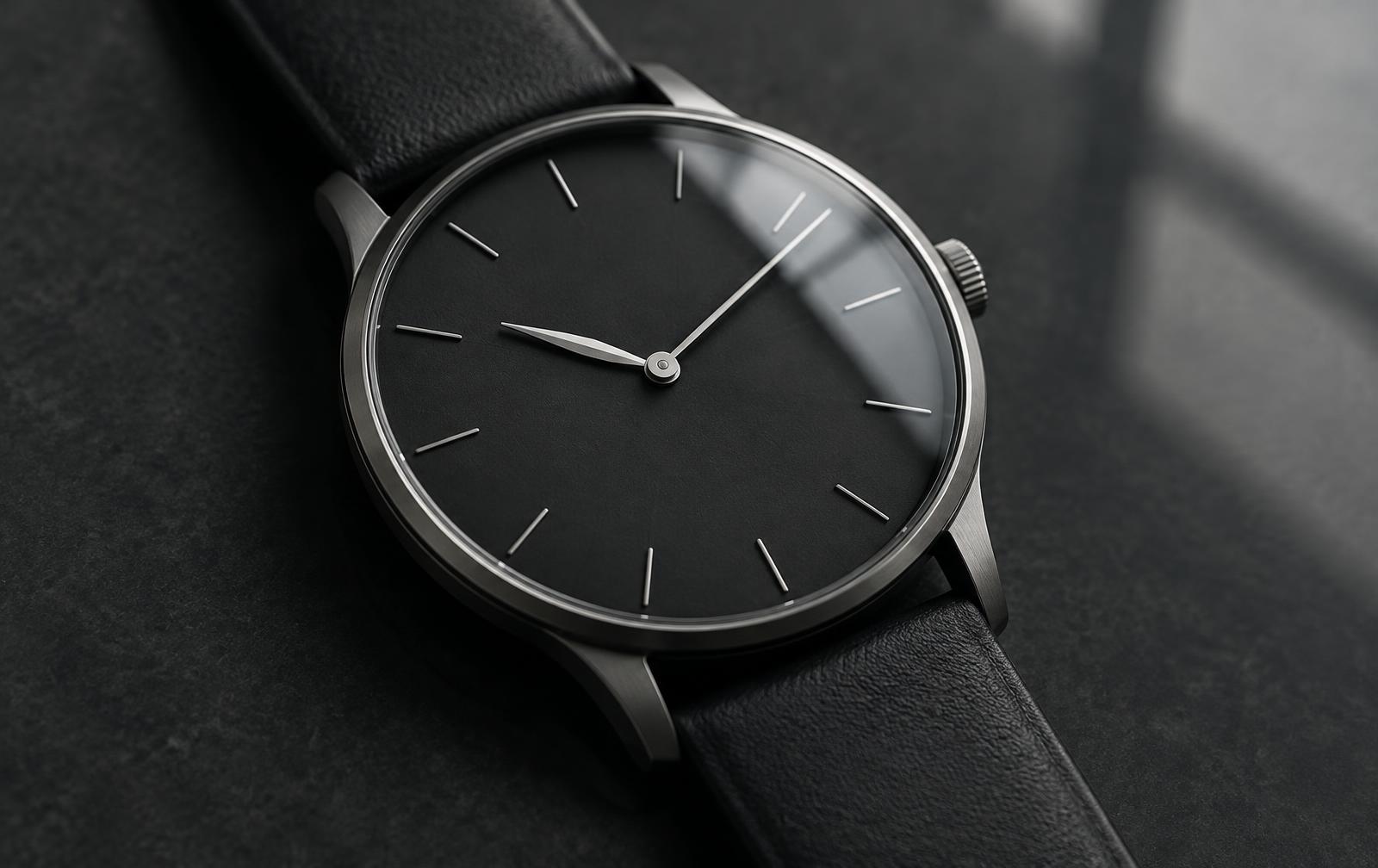
On a simple watch face, the minute hand reaches towards the markers around the rim. The hour hand stops closer to the centre. On the dial pictured here, the shorter hand is also broader, so you have two ways to tell them apart. Look at ten past ten and their tips sit well apart. At five past one, they almost meet. Those differences in length and weight become easier to appreciate when the two hands point in much the same direction.
Those differences in length and weight become easier to appreciate when the two hands point in much the same direction.
II
Reading the spaces
A dial with twelve plain strokes asks you to supply the numbers. The top of the watch establishes twelve, the mark directly opposite gives you six, and the equal spaces between them let you judge the rest. Your eye knows the quarter-hour positions particularly well. Even across a table, a long hand pointing straight down is enough to suggest half past.
Look closer and you can see what a minute track would add. On a face with only hour markers, you estimate the minutes by how far the hand has travelled between two strokes. A row of fine minute marks gives its tip a precise place to land.
A row of fine minute marks gives its tip a precise place to land.
III
A glance in passing
Lay a watch face up beside a window, then slip it onto your wrist. Flat on the table, the hands may stand out clearly against the dial. As you turn your arm, a reflection travels across the glass and briefly takes one of them with it. A slight roll of the wrist brings it back into view.
Think of that second glance for the train. Your eye is looking for the tip of one hand and the small stretch of dial between it and quarter past. There’s enough room in that gap to finish your coffee, or just enough to pick it up and go.
There’s enough room in that gap to finish your coffee, or just enough to pick it up and go.
Quiet. Minimal. Timeless.
← Back to Objects & Function