
The Design Code / Materials & Texture
Cotton & Structure
From soft jersey to crisp woven fabric. How one fibre takes on different forms.
A soft T-shirt, a crisp shirt and a substantial canvas bag can all be made from cotton. Their shared fibre gives little indication of how differently they will feel and behave.
The distinction lies in how the cotton is prepared, spun, constructed and finished. Those decisions influence the surface, weight and movement of the fabric.
Understanding cotton means looking beyond the composition label to the structure beneath it.
I
Fibre is the starting point
Cotton fibres grow around the seeds of the cotton plant. Once separated and prepared, they can be spun into yarn for weaving or knitting.
The properties of the fibre and the way it is processed contribute to the resulting yarn. Yarn thickness, twist and uniformity then help determine the character of the fabric.
A fine, smooth yarn offers different possibilities from a thicker, more visibly textured one. Neither tells the whole story about quality or suitability. Each needs to be considered in relation to the intended design.
II
Woven and knitted fabrics behave differently
Weaving interlaces sets of yarns, usually running lengthways and across the fabric. Knitting forms interconnected loops.
That difference in construction has a major influence on movement.
Many woven cotton fabrics hold a relatively defined shape, particularly along their length and width. Knitted fabrics generally offer more give because their loops can change shape under tension.
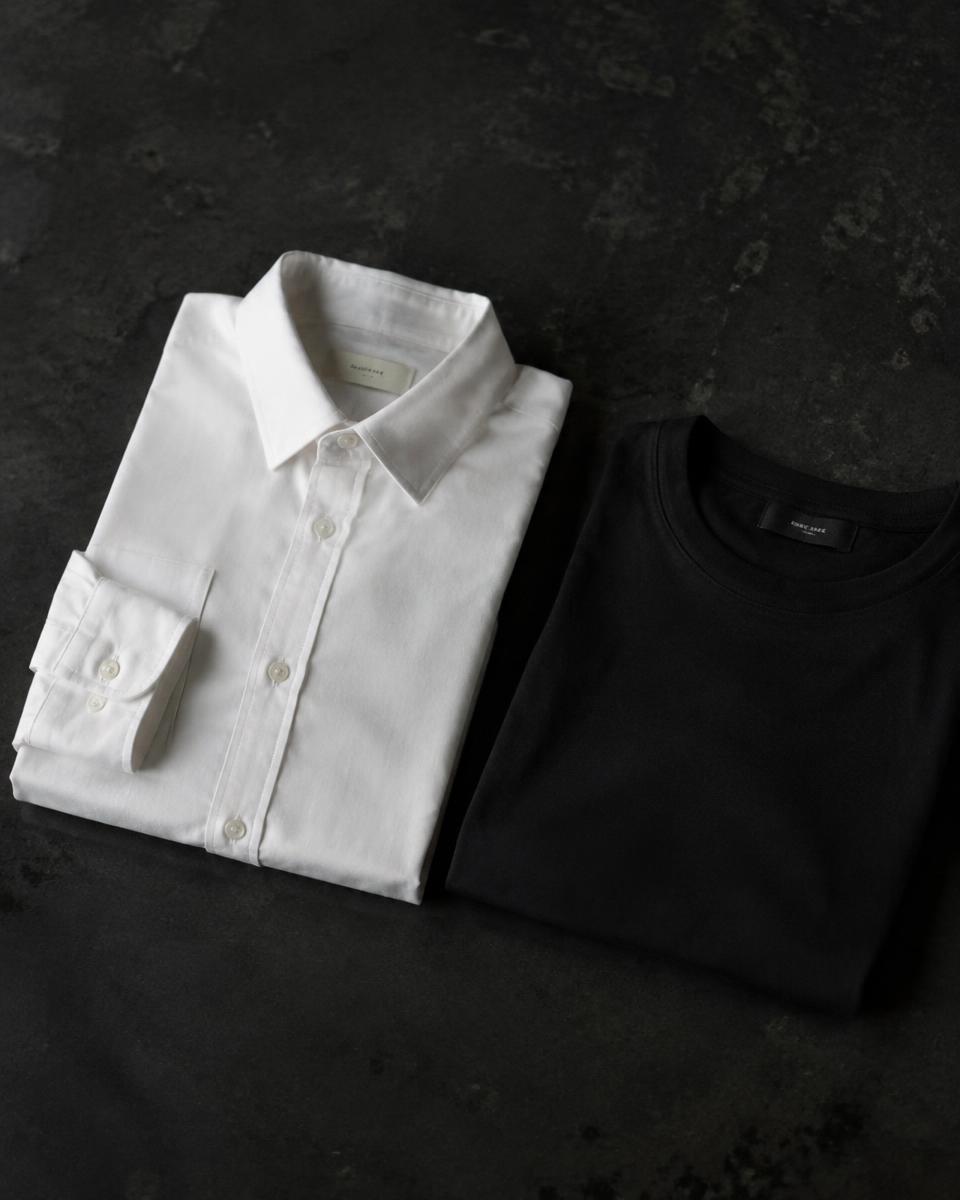
This helps explain the contrast between a familiar cotton shirt and a cotton T-shirt. The shirt’s woven fabric can support clearer edges, while the T-shirt’s knitted fabric moves more readily with the body.
Weight, density and finishing create further variation within both groups.
III
Jersey brings softness and movement
Cotton jersey is widely used for T-shirts and other everyday layers.
Its knitted construction allows flexibility, making it useful where the fabric needs to move with the wearer. A lightweight jersey may fall close to the body, while a heavier version can create a more substantial outline.
The neckline, sleeves and hem still depend on careful construction. Ribbing, bindings and seams help control those areas and support the intended shape.
A simple jersey garment therefore contains several structural decisions, even when its appearance is understated.
IV
Woven cotton offers different kinds of definition
Woven cotton includes a broad range of surfaces and weights.
Poplin typically has a close, plain-weave construction and a relatively smooth appearance. Oxford uses a basket-weave structure that gives a more visibly textured surface. Twill is recognisable by its diagonal weave, while canvas commonly provides a more substantial plain-woven fabric.
These names describe constructions or fabric types rather than a single fixed result. A lightweight twill can behave very differently from a heavy one.
Look at the actual fabric: how it bends, how clearly it holds an edge and how it responds when gathered or folded.
V
Weight changes the silhouette
Fabric weight is often expressed in grams per square metre, or GSM. It describes the mass of a given area of fabric.
A heavier cotton can give a garment more substance, but weight alone does not determine stiffness, opacity or durability. Yarn, construction and finish remain important.
A dense jersey may produce a broad, steady fold. A lightweight woven fabric may feel crisp despite its lower weight. Another fabric of similar weight may fall much more softly.
Use weight as one part of the description, then assess how the material behaves.
VI
Crispness and softness are design choices
The feel of a cotton fabric is often described as its handle: the impression it gives when touched, folded or moved.
A crisp handle can support a collar, emphasise a sleeve or hold fabric slightly away from the body. A softer handle can produce gentler folds and a more fluid outline.
Finishing processes can alter this feel. Brushing raises surface fibres to create a softer, more textured face. Washing and other treatments can change the fabric’s initial stiffness and appearance.
The right result depends on the piece. A structured overshirt and a soft base layer ask different things of their materials.
VII
Construction supports the fabric
A garment’s shape comes from the relationship between its fabric and the way it is made.
Seams connect panels and help establish their direction. Interlinings can support collars, cuffs and other areas that need additional stability. Bindings and reinforcing tapes can help control selected edges.
These elements need to work with the main fabric. Too much stiffness in one area may interrupt the way the rest of the garment falls. Too little support may prevent a detail from holding its intended form.
Turn a garment inside out and examine those connections. They often explain qualities that are only subtly visible from the outside.
VIII
Fit determines where the structure sits
The same fabric can create different silhouettes through changes in cut.
A broader body gives cotton more room to stand away from the wearer. A narrower sleeve changes how the fabric gathers around the arm. The position of a shoulder seam affects where the upper part of the garment begins to fall.
Fabric and fit should be assessed together. Adding width to a crisp cotton can create distinct volume, while a soft jersey may settle into folds.
Movement completes the picture. Sit, reach and turn to see where the material holds its shape and where it needs more room.
IX
Colour makes the surface visible
Cotton’s construction remains important within even the simplest palette.
A black jersey T-shirt and a black woven shirt can create a subtle contrast through their surfaces. White cotton reveals folds through shadow, while pale neutral tones can make small changes in weave easier to notice.
Finishes also affect reflection. A smoother surface may catch light differently from one that has been brushed.
These differences allow cotton pieces to work together without relying on patterns or strong colour changes.
X
Care helps preserve the intended form
Follow the care label for the finished garment. Cotton fabrics can respond differently to washing and drying according to their construction, treatment and any additional materials.
Avoid assuming that every cotton piece can be cared for in the same way. A lined jacket, a fine shirt and a jersey T-shirt may have different requirements.
When permitted by the label, gently reshaping after washing can help restore the intended outline. Pay particular attention to collars, seams and hems.
Care is part of maintaining the relationship between the fabric and the shape it was designed to hold.
XI
A closer look
Compare a cotton T-shirt with a woven cotton shirt.
Examine the surfaces closely. Look for the small loops of the knit and the crossing yarns of the weave. Gently test how each fabric gives in different directions without pulling hard.
Lift a sleeve and let it fall. Notice the size of the folds, the definition of the edge and how much volume remains.
The shared fibre is only the beginning. The construction explains much of the difference.
Through the EUVRΛN lens
Cotton offers a way to explore the relationship between everyday comfort and a clear silhouette.
A quiet design brings attention to the fabric’s weight, the shape of a sleeve and the finish of a neckline. These choices determine how a simple piece looks and feels in use.
For EUVRΛN, the useful question is how the material supports the intended form: enough definition to give the piece character, with room for everyday movement.
Quiet. Minimal. Timeless.
← Back to Materials & Texture