The Design Code / Design Movements
Minimalism
Reduction, repetition and the presence of materials. How a limited set of elements can hold our attention.
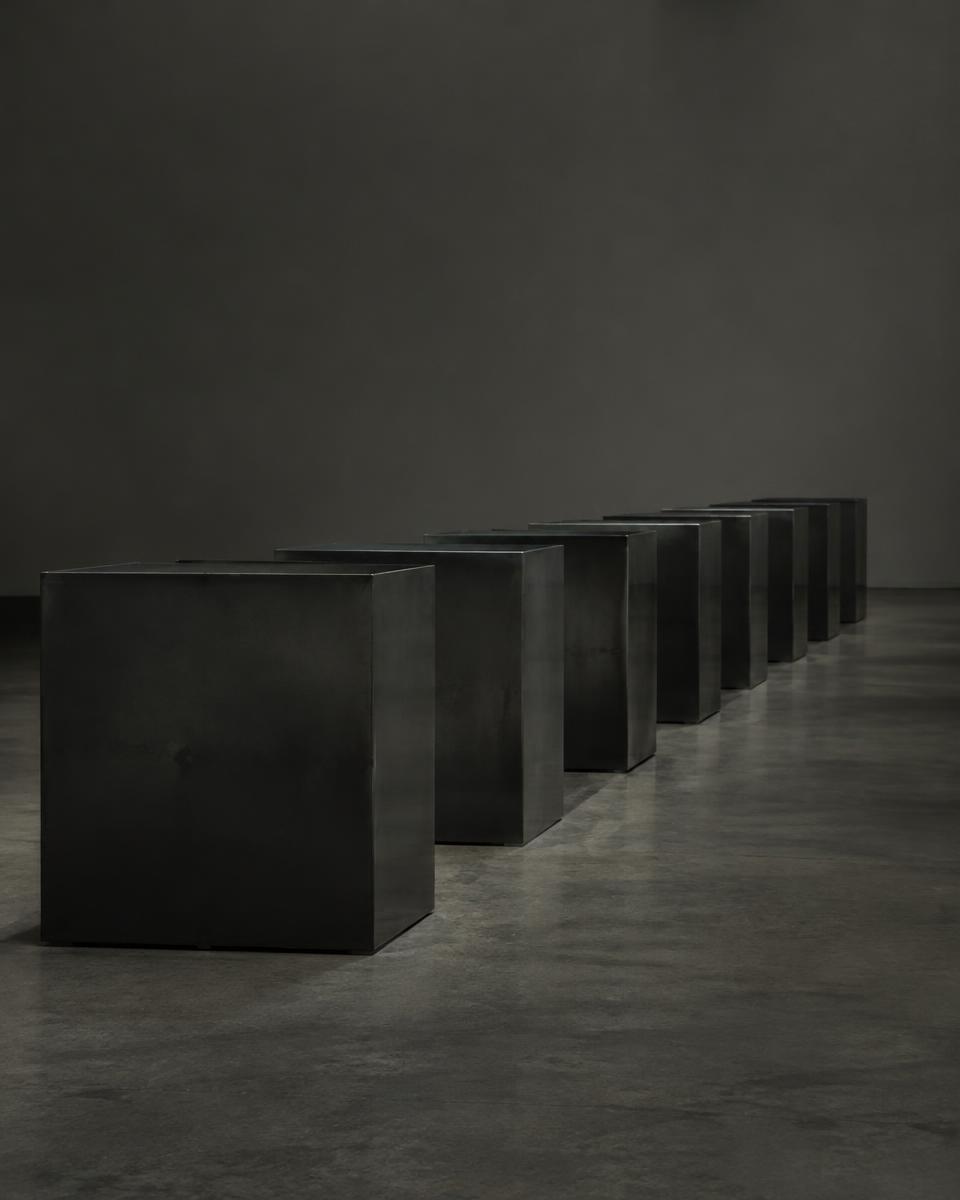
A repeated geometric form. A broad surface interrupted by a single edge. An object whose material becomes apparent as we move around it. Minimalism invites close attention to what is physically present.
The term has a particular history in art and a broader use in contemporary design. Understanding both gives us a clearer way to consider restrained clothing, objects and spaces.
Their interest often lies in relationships that become more noticeable when fewer elements compete for attention.
I
The artistic roots
Minimalism developed as an influential movement in American art during the 1960s. Artists explored simplified geometric forms, industrial materials and systematic arrangements, often moving away from representation and expressive gestures.
Figures associated with the movement include Donald Judd, Dan Flavin and Sol LeWitt, whose different practices explored objects, light and ordered structures.
The movement raised questions about what an artwork could be and how a viewer might encounter it. Its apparent simplicity opened up a more concentrated attention to form and material.
II
Materials became part of the subject
Minimalist artists frequently used commercial materials and industrial fabrication. Aluminium, fibreglass and manufactured lighting offered alternatives to traditional sculptural materials and visible handwork.
These choices could reduce the evidence of the artist’s personal touch and bring attention to the object’s physical construction.
For someone looking at design, this offers a useful question: what does the material itself contribute?
A reflective surface, a visible edge or a repeated joint can provide detail without additional decoration. Understanding the material becomes part of understanding the work.
III
Repetition creates a system
Repeated forms were important to many Minimalist works. Industrial processes and serial arrangements challenged the expectation that an artwork should be a single, uniquely handcrafted object.
Repetition also offers a way to examine small differences in position and perception.
A row of identical forms changes as we approach it from one end. Gaps become narrower or wider in perspective. Light may fall differently across each surface.
The repeated element establishes consistency, allowing its relationship with the setting to become more apparent.
IV
The surrounding space matters
An object is experienced in relation to its surroundings.
Its distance from a wall, its height above the floor and the room available around it all affect what we can see. Moving closer may reveal construction; stepping back makes the overall arrangement clearer.
This provides a useful way to approach restrained interiors and displays. The spaces between elements deserve the same attention as the elements themselves.
A carefully placed object can give an open area definition, while the surrounding area helps us appreciate its outline and scale.
V
Minimalist design has a broader meaning
In everyday design, “minimalist” commonly describes an approach that limits visual complexity through restrained forms, selective detailing and a clear arrangement.
This broader usage should be distinguished from the specific artistic movement. A simple shirt or uncluttered room does not automatically have a direct historical connection to 1960s Minimalism.
The connection is more useful when made through particular qualities: reduction, repetition, material presence or attention to space.
Naming those qualities helps explain what a design is doing.
VI
Reduction begins with purpose
In a practical object, simplifying the design requires an understanding of its use.
A pocket may interrupt a smooth surface while making a garment more useful. A handle may add another shape while allowing an object to be held comfortably. A label may provide information that someone needs.
Consider each element before removing it. What does it contribute? Could it be better integrated? Does the design still work without it?
Reduction becomes meaningful when it improves clarity while preserving the qualities people rely on.
VII
Fewer elements make decisions more visible
A restrained design brings attention to proportion, placement and finish.
When a shirt has little ornament, the collar, sleeve and hem become prominent parts of its character. On a plain cabinet, the alignment of doors and the treatment of edges are easy to notice.
The apparent simplicity can depend on considerable work behind the surface.
A clean outline may require careful pattern cutting or precise assembly. The finished appearance gives little indication of how many decisions were needed to achieve it.
VIII
Colour remains a possibility
A minimalist approach can include strong colour.
A single saturated surface may form the basis of an otherwise simple composition. A repeated colour can connect separate elements. A small accent can introduce a focal point.
Black, white and neutral palettes offer one route towards visual restraint, but they are not a requirement.
The more useful consideration is the role of each colour. Its scale, placement and relationship with the surrounding forms determine how it contributes.
IX
Texture can provide depth
A limited arrangement can still contain rich surface detail.
The grain of timber, the weave of fabric and the slight variations in a matte finish reward closer inspection. Light reveals these qualities differently as the viewer or object moves.
In clothing, texture can distinguish pieces within a closely related palette. A fine knit beside a smooth woven fabric creates variation without requiring a printed pattern.
Restraint leaves room for those differences to become part of the experience.
X
Comfort belongs in the composition
Minimalist interiors and objects still need to accommodate everyday life.
A room requires places to sit, move and keep useful belongings. A garment needs room for the body and appropriate protection. A tool needs a grip that works.
Softness, warmth and familiarity can all belong within a restrained design.
Assess the finished result through use as well as appearance. A composition that looks clear in a photograph may need adjustment once people occupy it.
XI
Appearance and ownership are separate choices
A minimalist-looking object does not automatically reduce consumption or have a lower environmental impact. Those questions depend on its production, usefulness and lifespan.
Likewise, an interest in restrained design does not require a fixed number of possessions.
It can instead encourage more specific decisions: keeping pieces that serve a purpose, understanding what is already available and considering whether a new addition contributes something worthwhile.
The visual approach and the way we live with things can inform each other without becoming identical ideas.
XII
A closer look
Choose a familiar object and identify its main elements.
Notice its outline, material, connections and any decorative details. Consider which parts support its use, which help communicate how it works and which primarily shape its appearance.
Imagine changing one element rather than removing everything at once. A smaller mark, a clearer edge or a more consistent spacing may be enough to improve the whole.
The exercise is about making decisions with attention.
Through the EUVRΛN lens
Minimalism offers EUVRΛN a way to consider the relationship between simplicity and substance.
A restrained palette gives fabric and silhouette room to remain visible. Subtle branding provides recognition at a smaller scale. Relaxed proportions bring the discussion back to movement and everyday use.
“More experience. Less excess.” extends that thinking to the things we choose and keep: pieces whose place in our lives is supported by how they feel, function and continue to be used.
Quiet. Minimal. Timeless.
← Back to Design Movements