
The Design Code / Design Movements
Japanese Design Perspectives
Material sensitivity, spatial awareness and everyday beauty. Different ways of looking closely at design.
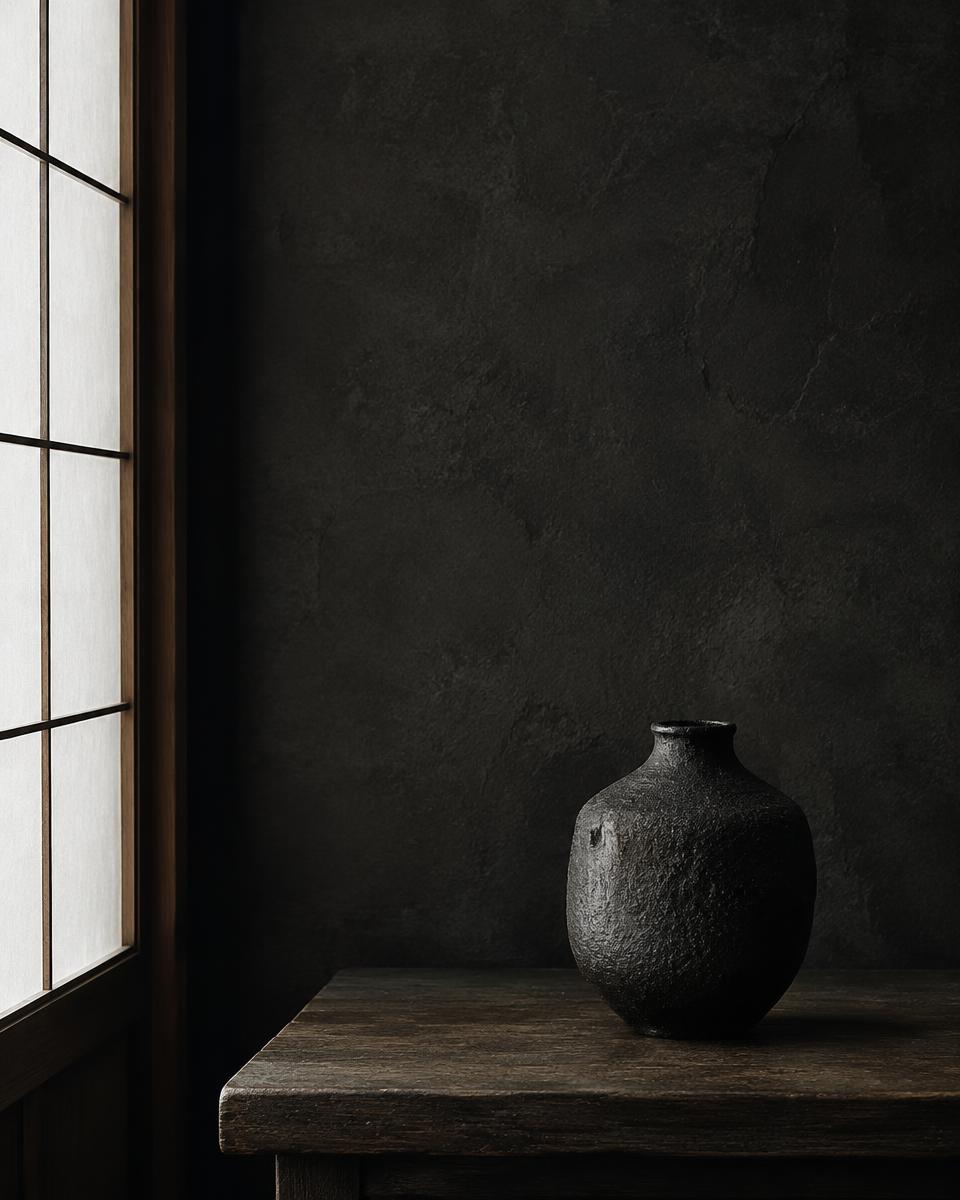
A ceramic bowl with an uneven glaze. The interval between objects in a room. A useful vessel shaped through repeated making. These offer different starting points for exploring Japanese design.
Japan’s design culture contains many traditions, movements and individual approaches. This guide focuses on a few specific perspectives: the significance of space, the appreciation of irregularity and the value found in everyday craft.
Each has its own context. Together, they encourage attention to how things are made, encountered and used.
I
Space can hold possibility
The Japanese terms ma and yohaku offer ways to consider the areas between and around elements.
Designer Hara Kenya describes ma as an interval that can be physical or temporal, while yohaku concerns the empty area surrounding something. His interpretation gives these spaces an active role: they leave room for expectation and imagination.
This provides a useful perspective on a page, an interior or an arrangement of objects. The gap contributes to the experience, influencing how one element relates to the next.
Consider a single vessel on a shelf. Its position and the space beside it help determine how we encounter its form.
II
Restraint can invite participation
A composition does not need to reveal everything at once.
An image partly obscured by mist asks the viewer to imagine what continues beyond it. A carefully placed object can suggest a wider arrangement. An interval gives us time to register what we have seen.
In his discussion of Japanese aesthetics, Hara distinguishes this capacity for suggestion from a purely rational reduction of elements. Emptiness can be understood as an opening for interpretation.
For design, the practical question is what should be made explicit and what can remain open to discovery.
III
Tea culture offers a particular perspective
Within Japanese tea practice, utensils are appreciated through use as well as appearance.
A bowl is held, its warmth felt and its surface observed alongside the tea it contains. The host selects objects for a particular gathering, making their relationships part of the occasion.
This connects visual appreciation with touch, action and setting.
It also offers a useful way to approach everyday objects. A cup’s rim, weight and balance become clearer when it is used. Its qualities emerge through an encounter rather than a photograph alone.
IV
Irregularity can be valued
The appreciation of rustic ceramics became important within sixteenth-century tea culture. Tea masters including Sen no Rikyū recognised qualities in Korean and Japanese vessels whose forms and surfaces differed from more conventionally refined objects.
The aesthetic known as wabi valued austerity, spontaneity and an apparently uncontrived character.
This history encourages a closer assessment of variation. An uneven outline or a changing surface may contribute to an object’s appeal.
That appreciation depends on judgement. An irregular feature can be expressive while the object still needs to work well for its purpose.
V
Colour and ornament also belong
Japanese tea ceramics include rough, unglazed vessels, smooth dark bowls and brightly decorated wares. Their contrasts can make the particular qualities of each more apparent.
This variety matters when looking at Japanese design more broadly. A muted palette and a sparse arrangement represent particular choices within a much wider field.
Begin with the object and its setting. Notice how colour, pattern and material contribute before assigning it to a general idea of simplicity.
VI
Mingei brought attention to everyday craft
The term mingei, commonly translated as folk crafts, was coined in 1925 by Yanagi Sōetsu and potters Kawai Kanjirō and Hamada Shōji.
The movement drew attention to the beauty of useful objects made for ordinary life, often by makers whose individual names were unknown. Yanagi later founded the Japan Folk Crafts Museum in Tokyo in 1936.
This provides a different starting point from the search for a celebrated designer or an exceptional showpiece.
An everyday bowl, textile or basket can reward attention through its construction, proportions and suitability for repeated use.
VII
Use reveals the design
One lesson we can draw from these perspectives is to examine objects through ordinary actions.
Pick up a vessel. Fold a textile. Open a lid. Notice where the hand naturally rests and how the material responds.
A pleasing outline gains another dimension when it works comfortably. A quiet surface may reveal detail through repeated handling.
These observations connect appearance with lived experience. They give us a more complete understanding of what makes an object worth keeping.
VIII
Materials deserve specific attention
A broad description such as wood, clay or cotton is only a beginning.
The particular material, its preparation and the maker’s technique influence the finished result. A surface may retain visible traces of construction or be carefully refined.
When exploring a piece, look for information about its maker, region and process. Those details help explain qualities that might otherwise be treated as a general aesthetic.
A visible weave becomes more interesting when we understand how it was made. A ceramic surface gains context when we learn what produced its colour and texture.
IX
Applying a perspective thoughtfully
An idea can inform contemporary work without being reduced to a visual formula.
An interest in ma might prompt closer attention to intervals and sequence. Learning about mingei might encourage an examination of useful, familiar objects. Studying tea ceramics might sharpen awareness of touch and material variation.
The connection becomes stronger when it is specific.
Describe the principle being explored and allow the new design to answer its own practical needs. Materials, users and circumstances still determine whether the result works.
X
A closer look
Choose an everyday object you regularly handle.
First, place it on a clear surface and observe the space around it. Move it slightly and notice how the arrangement changes.
Then use it. Pay attention to its weight, texture, edges and balance. Identify one quality that is difficult to appreciate through sight alone.
Finally, learn something about how it was made. Connecting observation with context turns a familiar object into a richer subject of attention.
Through the EUVRΛN lens
These perspectives offer EUVRΛN ways to think about space, material and the experience of everyday use.
A restrained arrangement can give a small detail room to be noticed. A visible weave can reward closer inspection. A relaxed silhouette can be assessed through movement and comfort.
Within The Design Code, these are points of exploration, grounded in an interest in the particular traditions and ideas behind them.
Quiet. Minimal. Timeless.
← Back to Design Movements