The Design Code / Design Movements
Bauhaus
Art, craft and industry in conversation. A school that reconsidered how everyday things could be made.
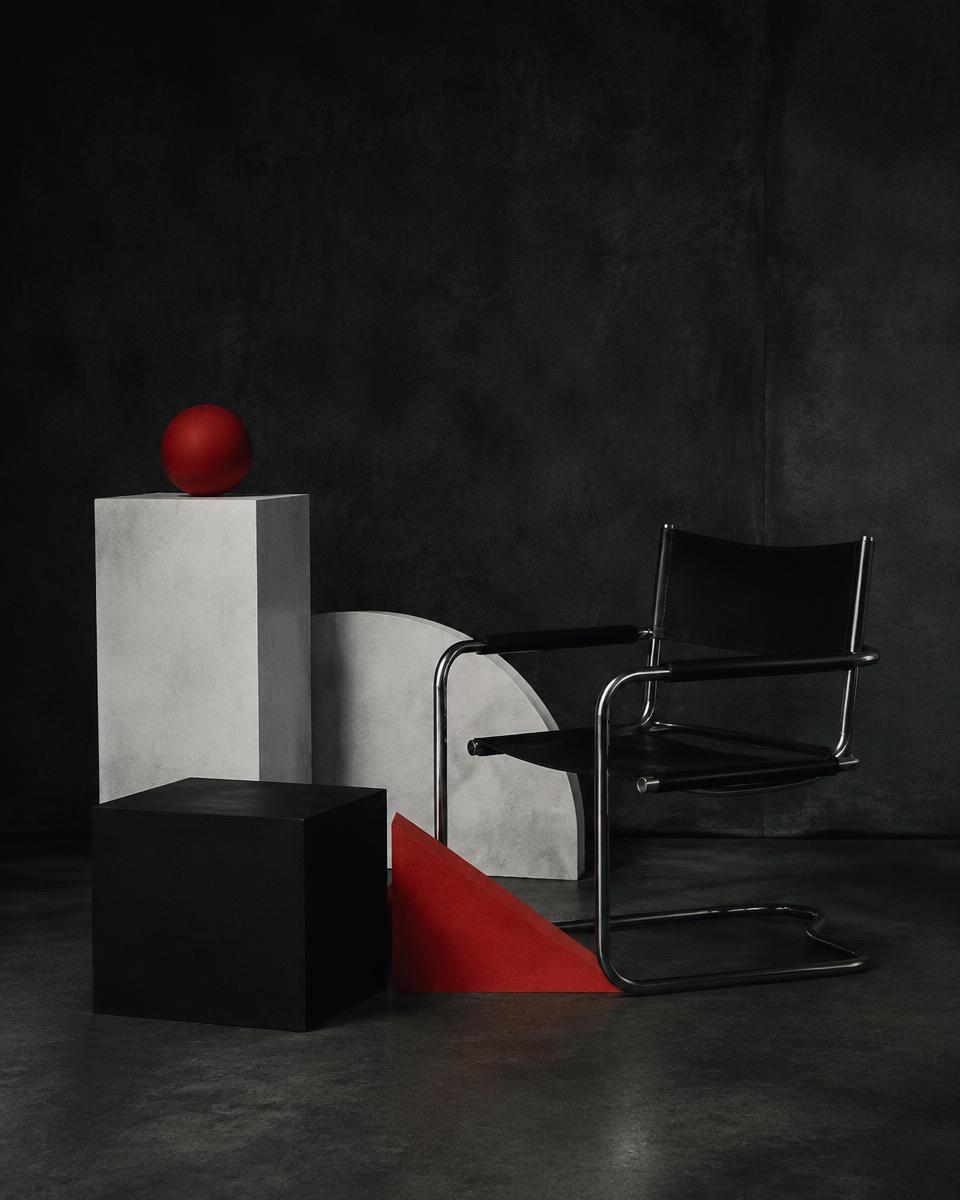
A chair with an exposed frame. A woven surface built from intersecting colours. A building whose windows reveal the activity inside. The Bauhaus brought different disciplines into a shared exploration of design.
Founded by architect Walter Gropius in Weimar, Germany, in 1919, the school sought to connect artistic ideas with practical making. Its workshops crossed boundaries between furniture, textiles, metalwork, graphics and architecture.
Its relevance begins with that breadth: the idea that understanding materials, form and use can connect objects of very different kinds.
I
A school that changed over time
The Bauhaus operated for only fourteen years, moving from Weimar to Dessau in 1925 and then to Berlin in 1932.
Its priorities evolved under three directors: Walter Gropius, Hannes Meyer and Ludwig Mies van der Rohe. Craft, industrial production, social needs and architecture received different emphasis across those years.
In 1933, following Nazi repression and the closure of its Berlin premises by the authorities, the teaching staff dissolved the school.
That changing history matters. The Bauhaus contained different viewpoints and experiments, rather than one fixed approach applied to every design.
II
Learning through materials
The preliminary course introduced students to fundamental questions of colour, form, composition and material.
Its teaching changed over time, with Johannes Itten, László Moholy-Nagy and Josef Albers bringing different approaches. Practical investigation helped students examine how materials behaved and how visual relationships could be constructed.
This offers a useful starting point for looking at design today. Before deciding what something should look like, examine what its material can do.
Fold a sheet. Bend a strip. Compare a rough surface with a smooth one. Observation can reveal possibilities that a drawing alone might miss.
III
Craft and industry became connected
The early school placed strong emphasis on craft. During Gropius’s leadership, its direction increasingly included designing for industrial production.
Workshops provided a setting in which practical skills could contribute to prototypes intended for wider manufacture. This raised questions about repeatability, construction and how objects might reach more people.
For a contemporary reader, the useful connection is between an idea and the means of making it. A design needs to work through its materials, components and assembly as well as its appearance.
IV
Geometry provides a way to explore relationships
Simple shapes offer a practical language for studying composition.
A circle beside a rectangle makes differences in outline immediately visible. Repeated lines establish rhythm. Changes in scale or spacing alter the relationship between elements.
These exercises help explain the appeal of geometric studies associated with Bauhaus teaching. They allow a small number of variables to be examined closely.
The lesson extends beyond a particular motif. A pocket, window or page margin can be considered through the same questions of shape, position and proportion.
V
Colour deserves close attention
Colour and form were important parts of the Bauhaus curriculum. Students explored them as subjects worthy of sustained investigation, alongside material studies and practical work.
That approach encourages us to look at colour in relation to its surroundings.
A red shape changes its presence when placed against white, black or grey. A small coloured area can organise attention within a much larger surface. Repeating it can connect separate parts.
For a restrained palette, this kind of observation is especially useful. Each colour has fewer competing elements around it, making its placement and proportion more apparent.
VI
Textiles were central to the work
The weaving workshop was among the Bauhaus’s most productive and successful workshops. It explored traditional craft techniques alongside industrial methods, with figures including Gunta Stölzl, Anni Albers and Otti Berger contributing to its work.
Its history also reflects the school’s unequal opportunities: a women-only textile class was merged into the weaving workshop in 1920.
Textiles deserve attention as constructed surfaces. Their patterns emerge through relationships between yarn, colour and technique.
For anyone interested in clothing, this provides a direct point of connection: fabric can be considered as a designed structure before it becomes part of a garment.
VII
Architecture brought disciplines together
The Bauhaus building in Dessau, designed by Gropius, connected workshops, teaching areas and other activities through an asymmetrical arrangement. Its extensive glazing and organisation became important expressions of modernist architecture.
It offers a useful example of a larger design accommodating different functions within one composition.
Look at how separate volumes meet, how openings reveal their purpose and how the building changes as it is approached from different directions. Architecture can be understood through movement as well as through a single image.
VIII
Influence continued through people
The school’s closure did not end the circulation of its ideas. Teachers, students and their networks carried approaches to design and education beyond its original locations and years of operation.
This helps explain why its influence reaches across disciplines. Teaching methods, material experiments and ways of organising work can travel alongside recognisable objects.
When examining a later design, distinguish a documented connection from a visual resemblance. Shared geometry alone does not establish a direct Bauhaus influence.
IX
Looking beyond the familiar image
A geometric poster or restrained chair can be an entry point into the subject, but each object deserves closer attention.
Ask how it was made, what it was intended to do and which decisions determine its form. Consider the material, the connections and the relationship between the object and its user.
These questions turn appreciation into understanding. They also help separate useful principles from a collection of decorative references.
X
A closer look
Choose a familiar object such as a chair, lamp or bag.
Identify its main function and the parts that make that function possible. Trace the structure, examine the connections and notice how colour guides your attention.
Then consider one change. Could a component be simplified? Would another material improve its use? Would removing a detail make the object clearer or less effective?
Treat the exercise as an investigation. The aim is to understand why each part is there.
Through the EUVRΛN lens
The Bauhaus provides a useful reference for exploring the relationship between form, material and everyday purpose.
Within The Design Code, its value lies in the questions it encourages: how a surface is constructed, how parts work together and how a small set of decisions gives an object its character.
EUVRΛN’s restrained palette and simple geometry offer points of comparison. Those visual connections become more meaningful when accompanied by attention to construction, comfort and use.
Quiet. Minimal. Timeless.
← Back to Design Movements