
The Design Code / Place & Culture / 03
The Curves of Rio
Why the wave-patterned promenade at Copacabana feels different at walking pace.
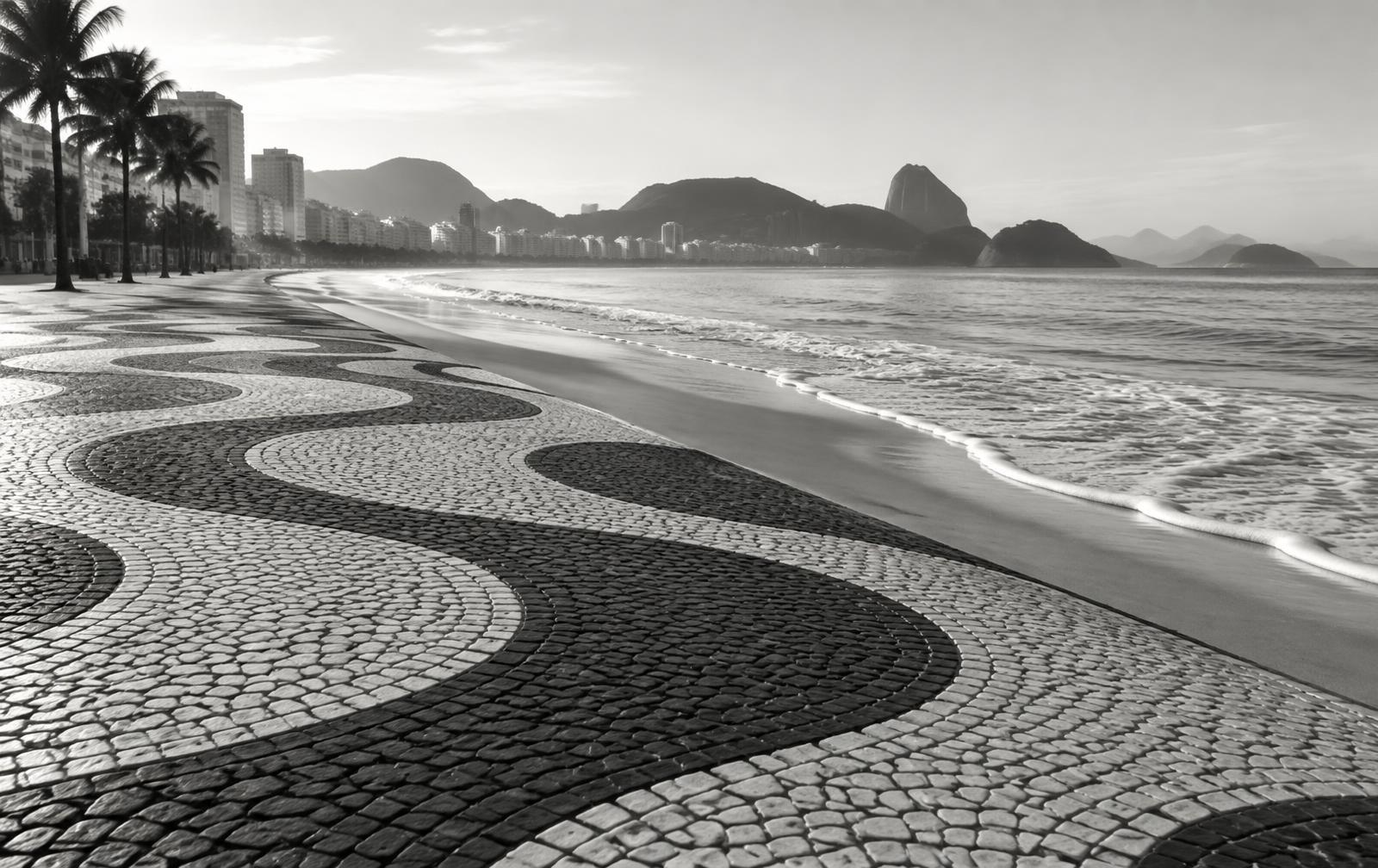
Stand on the promenade at Copacabana and look down. The edge of a black wave is surprisingly rough up close. Small paving stones meet at slightly different angles, each making a short section of the bend.
Look a few paces ahead and those uneven edges resolve into a curve. Across the sand, a line of foam is already breaking up where the water has begun to draw back.
I
A curve made by hand
The pavement belongs to a tradition of Portuguese stone mosaic known as calçada portuguesa. Follow the line where black meets white. Each stone has to sit close enough to its neighbours to hold the pattern together, even where the band turns back on itself. At your feet, you can see the individual decisions that make the bend possible. From an upstairs window, the same stretch of paving reads as a single sweep.
From an upstairs window, the same stretch of paving reads as a single sweep.
II
Along the bay
Walk beside the beach for a while and pick out a building further along the waterfront. At first, you see it beyond a row of façades. As the shore bends, more of its windows come into view. The change is gradual enough to escape your notice until you stop and look back. The stretch of beach you set out from now lies across the water at an angle to where you stand.
The mosaic gives that long walk a smaller measure. You can follow one black band with your eye, lose it beneath a bench and find the next bend a few steps on.
You can follow one black band with your eye, lose it beneath a bench and find the next bend a few steps on.
III
At walking pace
For a child, the dark stones offer a winding path to follow with both arms out. Someone running beside the beach cuts straight across the same waves. Two people drawn into conversation might spend half an hour on a bench with the pattern at their feet.
Come back along the promenade and you can find the precise bend where you stopped, down to a pale stone tucked into its edge. Out on the sand, the tide has already drawn the shoreline somewhere else.
Out on the sand, the tide has already drawn the shoreline somewhere else.
Quiet. Minimal. Timeless.
← Back to Place & Culture