
The Design Code / Place & Culture / 02
New York on the Grid
What Manhattan’s numbered streets and avenues do to your sense of distance.
Walk up a Manhattan avenue with someone who knows the neighbourhood and their directions will probably come in blocks. Two more, then a left. It sounds like a precise measure until you make the turn.
Along much of Manhattan’s grid, the walk between avenues is longer than the walk between numbered streets. You can feel the difference in how long you get to finish a conversation before the next crossing.
I
The long view
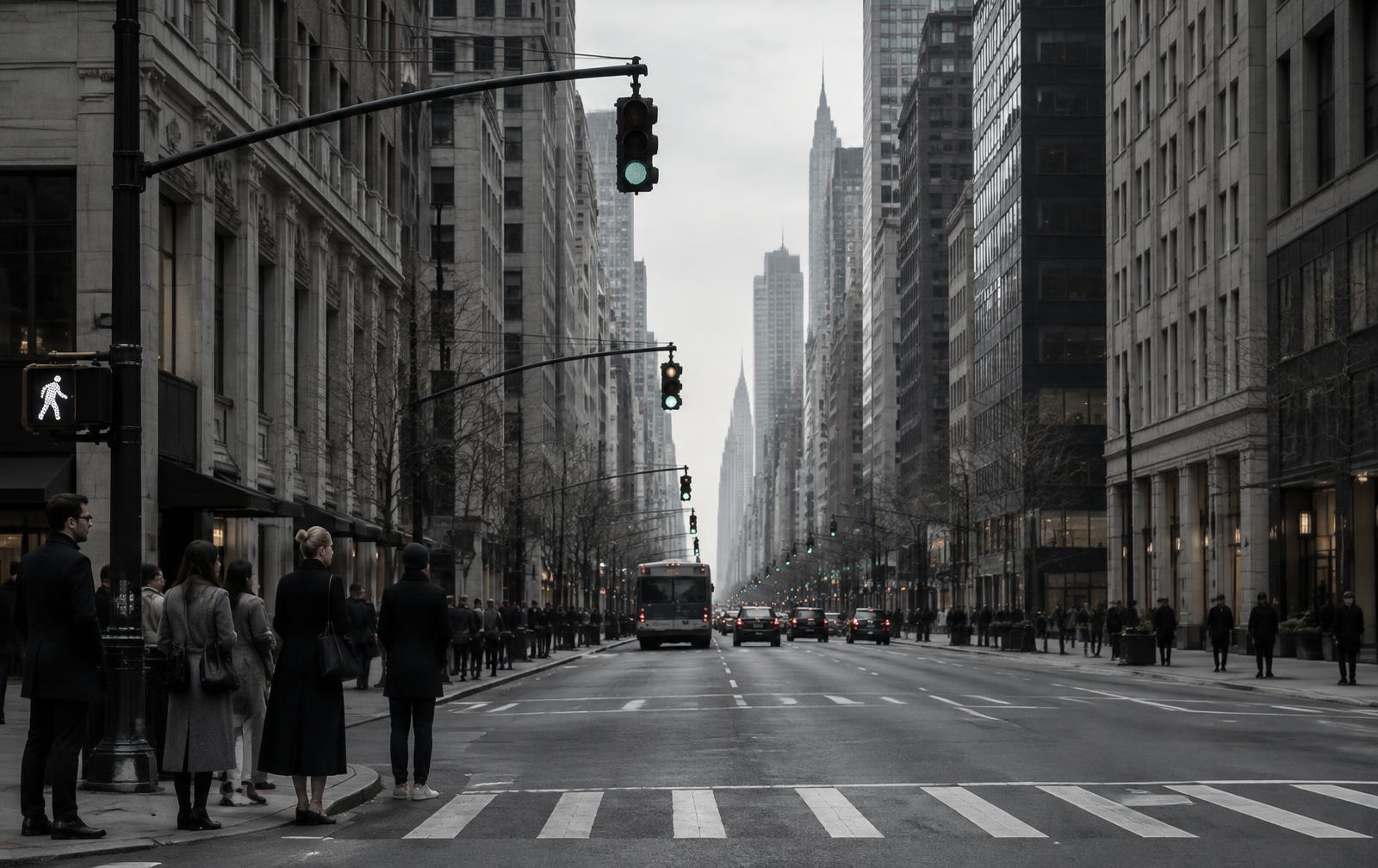
Stand at the kerb and look up the avenue. Traffic lights hang one beyond another. A bus a few streets ahead pulls out, briefly clearing your view of the next one. With so much of the route visible, you can find yourself watching a light change at a corner you won’t reach for several minutes. A shopkeeper lifting a shutter beside you brings your attention back to the few feet of pavement you actually occupy.
A shopkeeper lifting a shutter beside you brings your attention back to the few feet of pavement you actually occupy.
II
One turn in
Turn onto a residential side street and the view breaks into smaller intervals. Each iron railing ends at a gate. Each flight of stone steps rises to a different door. A stoop puts the entrance above the pavement and gives the household a place to sit within speaking distance of anyone passing. A neighbour on the second step can catch up on the morning’s news with someone who keeps one hand on a pushchair. Neither has to go out of their way.
A stoop puts the entrance above the pavement and gives the household a place to sit within speaking distance of anyone passing.
III
Back at the crossing
At the next avenue, the light holds everyone for a moment. A cyclist rests one foot on the kerb. Someone shifts a paper bag to the other arm. When the signal changes, the group crosses together and comes apart again on the far side.
When the signal changes, the group crosses together and comes apart again on the far side.
Through the EUVRΛN lens
New York is the starting point for EUVRΛN’s second volume. One detail worth taking from this walk is the stoop.
On a map, the block is a rectangle much like the next. Ask someone where they spent the afternoon and they might name a single step, the one that stays in the sun long enough for two people to sit and talk.
Quiet. Minimal. Timeless.
← Back to Place & Culture