
The Design Code / Place & Culture / 04
From Place to Garment
How the streets we walk, the transport we take and the weather we live in shape the clothes we make.
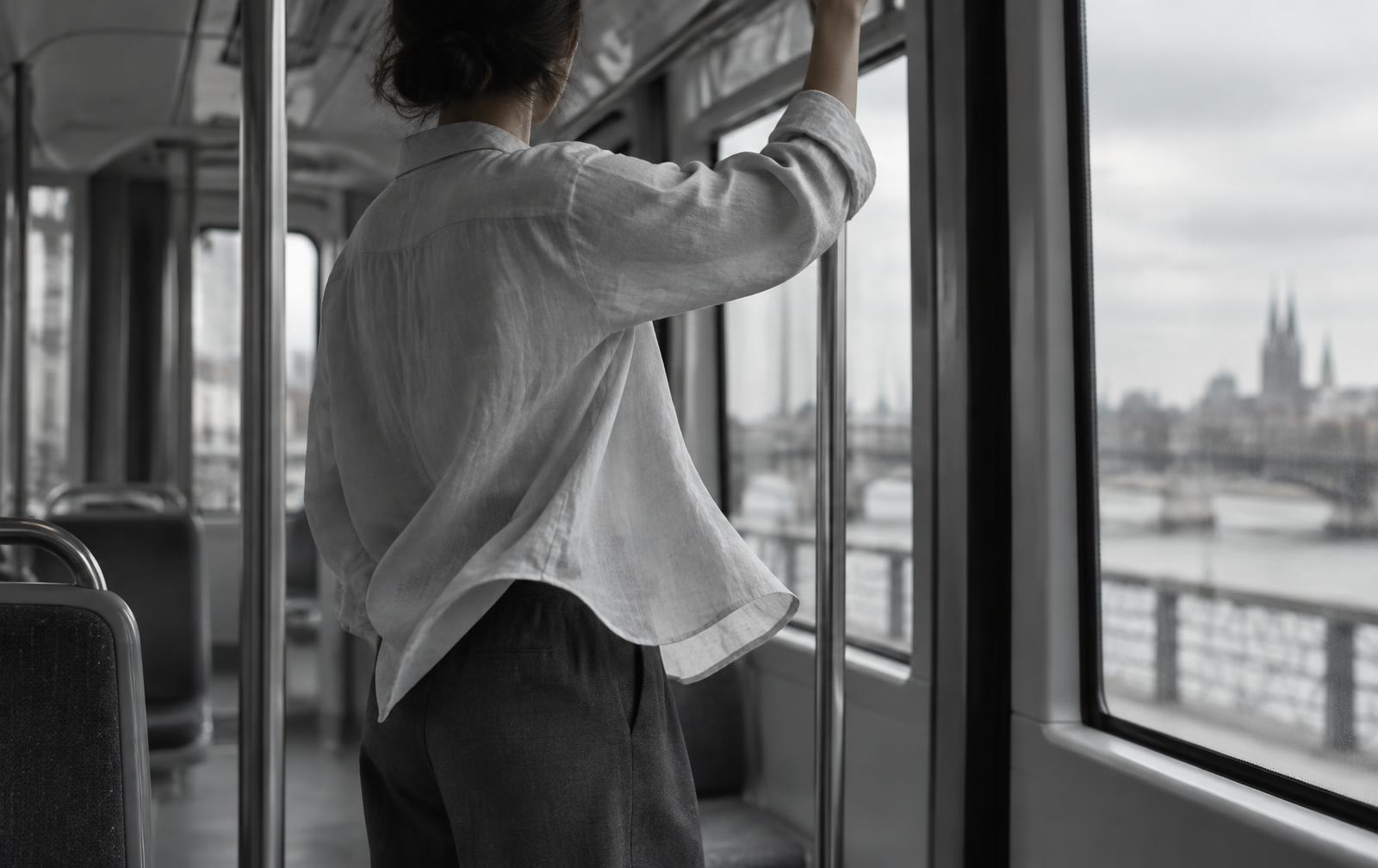
On a hanger, a shirt tells you a little about its shape. Fasten it, sling a bag over one shoulder and reach up for a tram rail, and you learn where the fabric has room to move.
Watch the hem as your arm rises. If it lifts a long way, you may find yourself pulling the shirt back into place at every stop. An ordinary journey gives a designer something quite specific to work on.
I
Cloth in the heat
Step out of a narrow Hong Kong street and onto the ferry deck. A breeze catches the back of your shirt. How that feels depends partly on the space between cloth and skin. A light fabric cut close can cling across the shoulders. A little more room lets the breeze lift it away.
That makes choosing cloth and deciding on a cut part of the same job. Hang two linen samples over your hand. One may settle into soft folds between your fingers while the other holds a small arch across your knuckles. Cut to the same pattern, they will give the wearer different amounts of space.
That makes choosing cloth and deciding on a cut part of the same job.
II
The reach of a sleeve
Back on the tram, that overhead rail offers a test for the sleeve. A low armhole can look generous while your arm hangs at your side. Raise your hand and the sleeve can take up its slack, then draw the body of the shirt upwards with it. An armhole cut closer beneath the arm, with enough width through the upper sleeve, can let you reach further before the hem starts to move.
An armhole cut closer beneath the arm, with enough width through the upper sleeve, can let you reach further before the hem starts to move.
III
A pocket on the steps
Sit on a New York stoop and try reaching for the keys in your shorts. Sitting changes the angle of your thigh and draws the fabric across your lap. A pocket that was easy to reach while standing can press closed. A small change to the angle of its opening can be the difference between slipping your hand inside and having to stand up again.
A small change to the angle of its opening can be the difference between slipping your hand inside and having to stand up again.
Through the EUVRΛN lens
These are the observations EUVRΛN takes from a place. Hong Kong can find its way into the cut of a shirt through something as modest as the height of a tram rail.
You feel the connection when you raise your arm, find your grip and carry on with the conversation.
Quiet. Minimal. Timeless.
← Back to Place & Culture