
The Design Code / Photography & Composition / 04
Seeing in Monochrome
Why removing colour changes what a photograph is about.
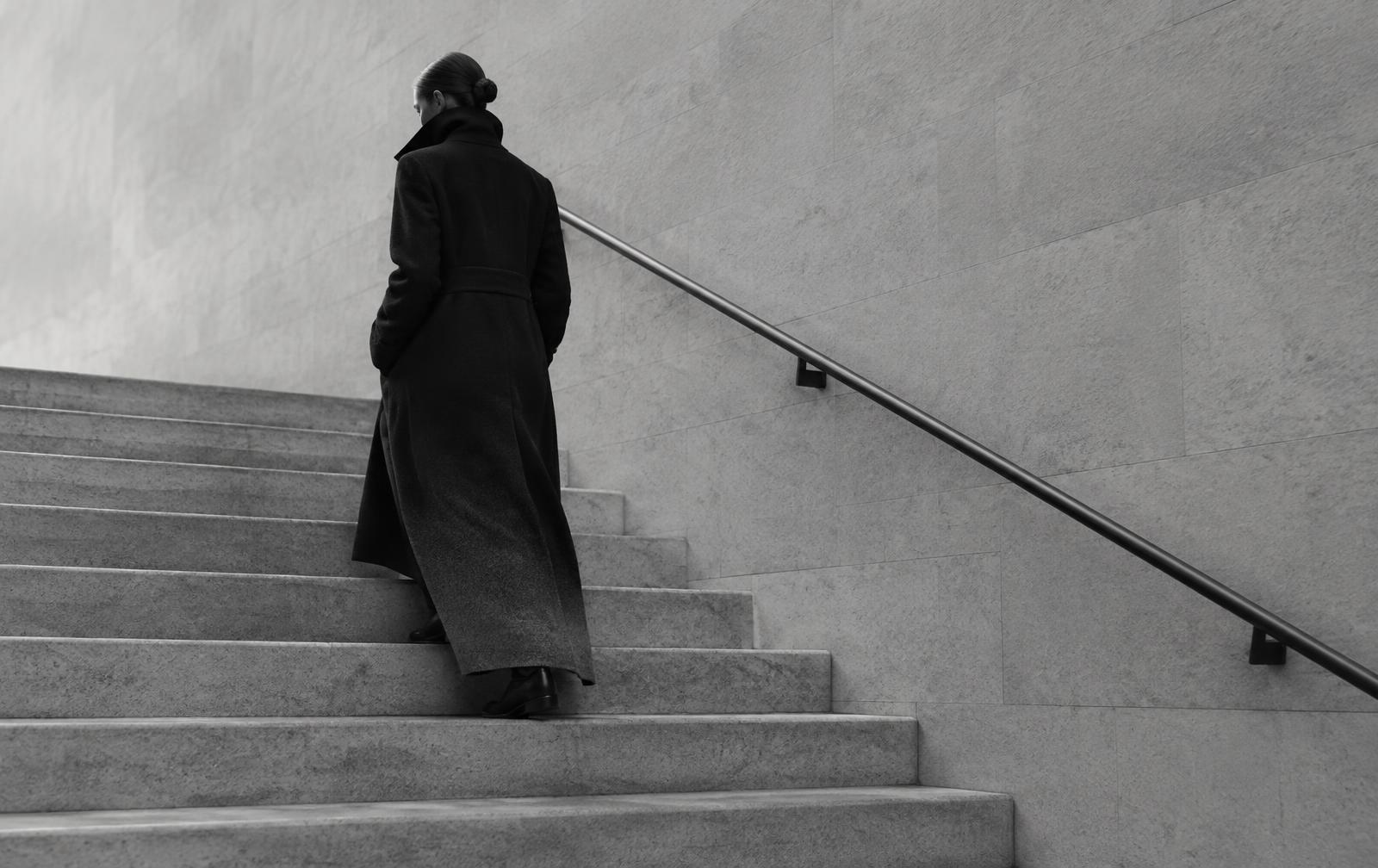
A figure in a dark coat climbs a stone staircase. Follow the handrail up from the lower right and it brings your eye towards the figure’s shoulder. From there, you can trace the raised collar against the pale wall.
Lower down, the hem meets a step of almost the same grey and part of the coat seems to disappear. Notice how little of its outline you need to recognise someone walking away.
I
When colours share a grey
A red chair against a green wall can be the first thing you notice in a colour photograph. Switch to black and white and the chair may almost disappear. Its colour made it easy to pick out. Whether it stands out in monochrome depends on tone, how light or dark it appears beside the wall.
Look again at the chair. Perhaps a little light catches the top of its backrest, or one leg crosses a pale strip of floor. Those small differences can hold the shape together even when two colours settle into a similar grey.
Whether it stands out in monochrome depends on tone — how light or dark it appears beside the wall.
II
What texture tells you
Look closely at the coat on the stairs. Light catches the ridge of a fold and fades gradually across the cloth. On the step beneath it, a worn stone edge makes a much sharper line. Even where coat and stone share a tone, the way the light changes across each surface gives you a feel for the material.
Even where coat and stone share a tone, the way the light changes across each surface gives you a feel for the material.
III
Choosing where the eye lands
Try framing a dark coat against a shaded doorway. Keep your subject still and move sideways until the shoulder meets a lighter patch of wall. Take a photograph from each position, then view both in black and white at thumbnail size.
At that scale, the weave of the coat is hard to see. The light along the shoulder still reads. Enlarge the photograph again and the smaller details return. That order matters. The shoulder draws you into the picture. The folds give you somewhere to linger.
The shoulder draws you into the picture. The folds give you somewhere to linger.
Quiet. Minimal. Timeless.
← Back to Photography & Composition