
The Design Code / Photography & Composition / 03
Perspective & Scale
How camera height changes the relationship between a person and the space around them.
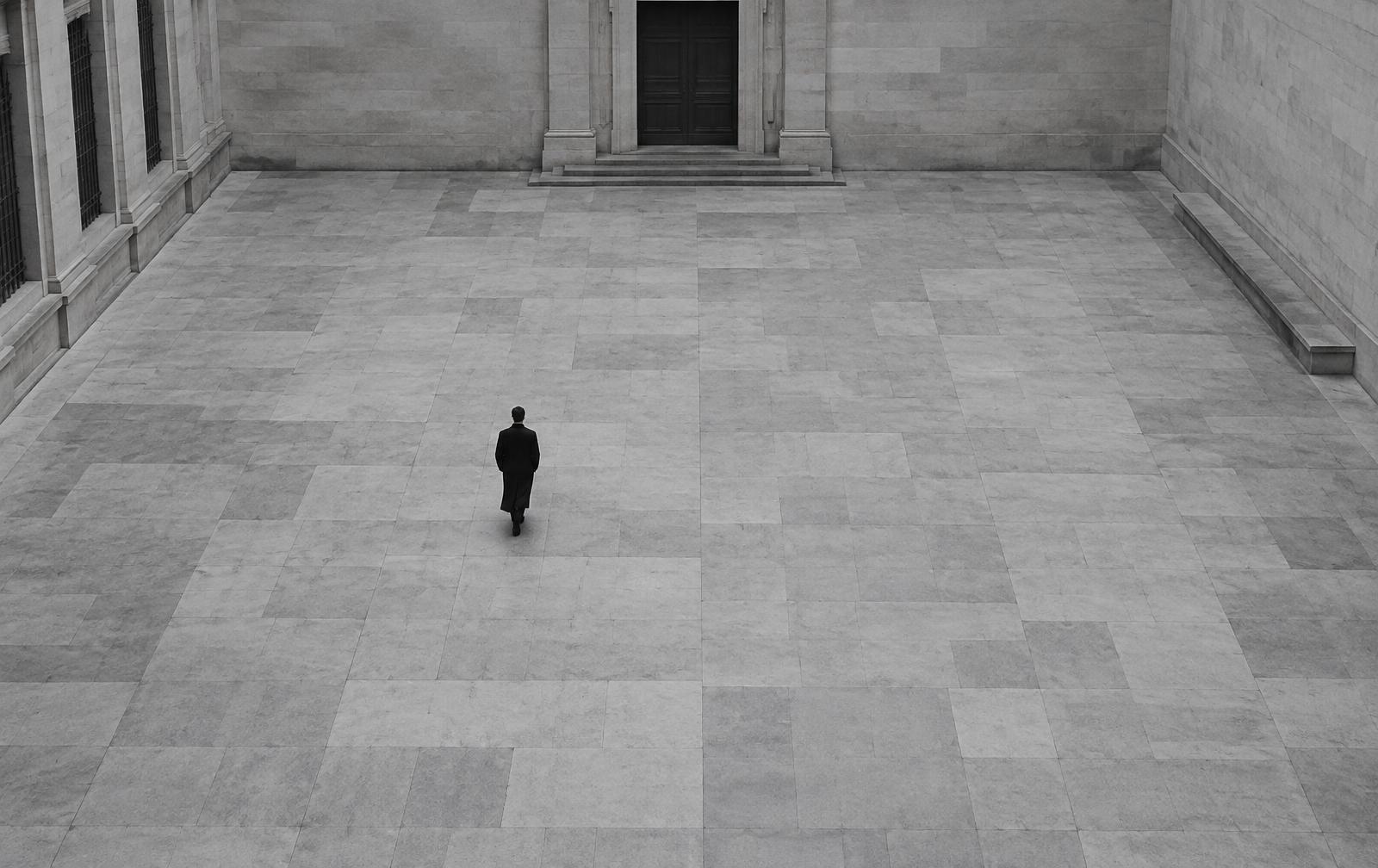
A lone figure crosses a paved courtyard. From above, you can see the ground ahead of them, the ground they’ve already crossed and the distance to the nearest door. Cover the figure with your thumb and the paving becomes a pattern of rectangles.
Lift it again and you can almost count the strides it would take to reach the other side.
I
The view from the steps
Imagine taking that photograph from the foot of the steps. At eye level, the paving stones overlap in your view. The nearest ones fill the bottom of the frame, and those across the courtyard appear as narrow strips. A person passing close to you might briefly hide the doorway.
Climb to the landing and look again. A stretch of paving now separates the walker’s head from the door in the photograph. You can follow their route across the joints in the stone. That change in viewpoint is perspective. It affects which things overlap, how large they appear beside one another and how much of the space between them you can see.
Perspective affects which things overlap, how large they appear and how much of the space between them you can see.
II
A measure you recognise
A photograph of a blank concrete wall offers few clues to its size. Bring a handrail into the frame and you have a height you know from the feel of one under your palm. A person standing beside the wall gives you another way to judge it. You can look from their shoulder to the top edge and imagine standing there yourself.
Placement matters. Someone close to the camera can appear as tall as a building across the square. Move them beside its entrance and their height tells you something about the building itself.
Move them beside its entrance and their height tells you something about the building itself.
III
Two views of one crossing
Try photographing someone crossing a courtyard, first from ground level and then from a landing above. Keep the same lens and wait for them to reach the same paving joint on each pass.
Look at where their silhouette falls in each frame. At street level, their coat might blend into a dark doorway until a sleeve catches the light. From above, the whole figure might stand clear against pale stone. In one photograph you notice the turn of a shoulder. In the other, you feel the length of the walk.
In one photograph you notice the turn of a shoulder. In the other, you feel the length of the walk.
Quiet. Minimal. Timeless.
← Back to Photography & Composition